2026 Top DIN Abrasion Resistance Tester Types to Buy?
Choosing among the 2026 top DIN Abrasion Resistance Tester types requires more than comparing prices or display screens. Rubber compounds may look identical, yet their wear results can differ sharply under controlled testing. A reliable instrument must reproduce the specified load, abrasive path, specimen movement, and measurement procedure. The relevant foundation is ISO 4649:2017, which describes rubber abrasion testing with a rotating cylindrical drum. Many laboratories also compare results with ASTM D5963, especially when qualifying tires, footwear soles, belts, seals, and molded components.
Industry outlooks support continued demand for dependable rubber testing. Smithers’ “The Future of the Global Rubber Industry to 2028” identifies automotive, industrial, and tire applications as major technology drivers. Grand View Research reports continuing growth in rubber-related manufacturing, where durability testing helps reduce material waste and field failures. These reports do not select a machine for your laboratory. They do show why repeatability, traceability, and service support matter.
The most practical choices usually include standard DIN drum testers, automatic abrasion testers, and multifunctional systems with digital measurement and data export. A typical test may use a calibrated abrasive sheet, a 10 N load, and a 40-metre sliding distance. Small details matter. Poor clamping can distort the result. Uneven specimen preparation can do the same. A lower-cost tester may be suitable for routine production checks, while an automated model better supports research, audits, and multi-shift laboratories. No buying list is perfect. Even experienced engineers should verify calibration records, reference materials, spare-part availability, and operator training before purchase.
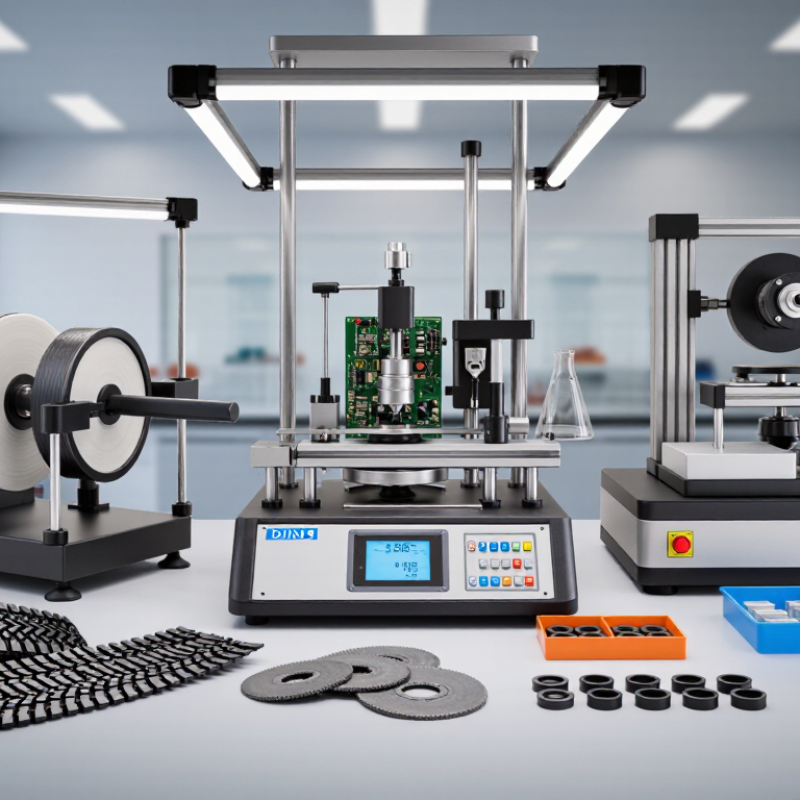
What Is a DIN Abrasion Resistance Tester?
A DIN abrasion resistance tester measures how much rubber or elastomer wears under controlled friction. It uses a rotating cylindrical drum, abrasive paper, and a fixed test specimen. The machine records mass loss, then converts it into volume loss. Lower volume loss usually indicates better abrasion resistance.
The method follows DIN 53516 and relates closely to ISO 4649:2017. These standards report abrasion as cubic millimetres, using a reference compound for comparison. A typical test applies a 10 N load while the specimen travels across the abrasive surface. Small differences matter. A dusty drum, uneven sample, or incorrect calibration can distort the result.
Choose a tester with adjustable load, stable drum speed, accurate specimen holders, and traceable calibration. These details affect repeatability more than a polished control panel. IRSG’s World Rubber Industry Outlook places global rubber demand near 31 million tonnes in 2024, increasing the need for dependable wear testing across tires, seals, belts, and footwear. Yet abrasion results do not predict every field condition. Temperature, moisture, pressure, and road texture can change performance. I have seen promising laboratory samples fail after heat exposure. That is not a machine error. It is a reminder to combine DIN testing with application-specific trials.
How DIN Abrasion Testing Works
2026 Top DIN Abrasion Resistance Tester Types to Buy?
How DIN Abrasion Testing Works
A DIN abrasion tester measures how much material a rubber specimen loses during controlled rubbing. The test uses a rotating abrasive drum, a cylindrical sample, and a specified contact load. As the drum turns, the specimen travels across the abrasive surface for a fixed distance. The process looks simple. The details matter.
Before testing, technicians condition the specimen under controlled temperature and humidity. They measure its mass and check its dimensions. The sample is then pressed against the drum, usually with a defined force. After abrasion, loose particles are removed carefully. The technician measures the final mass and calculates mass loss. With the material density, mass loss becomes volume loss, commonly reported in cubic millimetres.
A reliable DIN tester needs stable drum speed, accurate loading, and consistent abrasive sheets. Operators should inspect the track for contamination or uneven wear. Small preparation errors can change the result. That is easy to overlook. Some laboratories choose standard drum testers for routine rubber comparisons, while others need programmable models for heavier production testing. The correct type depends on sample size, test frequency, data recording needs, and compliance with applicable methods such as DIN 53516 or ISO 4649.
The method is useful, but not perfect. It represents one wear condition, not every road, floor, or working environment. A careful engineer compares DIN results with field evidence before approving a material.
2026 Top DIN Abrasion Resistance Tester Types to Buy? – How DIN Abrasion Testing Works
DIN abrasion testers commonly use a rotating cylindrical drum covered with standardized abrasive paper. The specimen is pressed against the abrasive surface under a defined load and travels a fixed abrasion distance. Abrasion performance is typically calculated from mass loss and material density, then reported as volume loss in mm³.
The chart shows commonly specified reference conditions associated with the DIN 53516 / ISO 4649 abrasion method. When selecting a tester, verify that it can control these parameters accurately and supports the required specimen dimensions.
Main Types of DIN Abrasion Resistance Testers in 2026
In 2026, DIN abrasion resistance testers are not one uniform machine. Their main difference is how they control motion, load, and measurement. The classic rotary-drum tester remains common in rubber, elastomer, and flooring laboratories. A cylindrical specimen presses against abrasive paper inside a rotating drum. After a defined distance, the operator measures mass loss or volume loss. It is simple to understand. That simplicity can expose mistakes.
Manual drum testers suit low-volume laboratories and training rooms. They require careful specimen preparation, load checking, and balance readings. Semi-automatic models control drum speed and test distance, reducing timing errors. Fully automatic DIN systems can manage loading, stop points, data capture, and repeated cycles. Digital versions may calculate volume loss after entering density. However, software cannot repair a poorly cut specimen. This point is easy to overlook.
For frequent quality control, choose an automatic unit with traceable calibration, stable clamping, and replaceable abrasive paper. A clear enclosure helps protect the test area from dust and accidental contact. For research, programmable systems offer richer records and comparison options, but they cost more and require trained users. Check compliance with DIN 53516 and your internal method before buying. Ask whether the instrument supports reference materials and service verification. I would not select a tester from screen features alone. Real repeatability matters more than a polished interface.
Key Features for Comparing DIN Abrasion Testers
2026 Top DIN Abrasion Resistance Tester Types to Buy?
Key Features for Comparing DIN Abrasion Testers
A reliable DIN abrasion tester must match the method behind your data. DIN 53516 and ISO 4649 commonly use 16 mm cylindrical specimens, controlled loading, and a 40 m abrasion path. Check whether the instrument supports both 5 N and 10 N loads. Small differences can change mass-loss results.
Repeatability matters more than a polished screen. Look for a calibrated load cell, stable abrasive-drum speed, automatic specimen rotation, and a readable balance with at least 0.001 g resolution. An enclosed test chamber helps control dust and protects operators. According to ISO 4649, laboratories should control specimen conditioning and surface preparation before testing. Without that discipline, advanced hardware cannot rescue weak data.
Automation reduces handling errors. A 2024 Smithers rubber-testing market analysis identifies automated quality control as a continuing equipment demand driver. Choose software that stores raw mass, test distance, operator ID, and calibration history. Data export should be simple. Very simple.
I would also compare abrasive-paper tracking and drum alignment. These features are easy to overlook. A tester may pass a factory demonstration yet drift during long production runs. ASTM D5963 offers another reference for rubber abrasion evaluation, but its settings are not automatically interchangeable with DIN results. Buy the method, not merely the machine.