
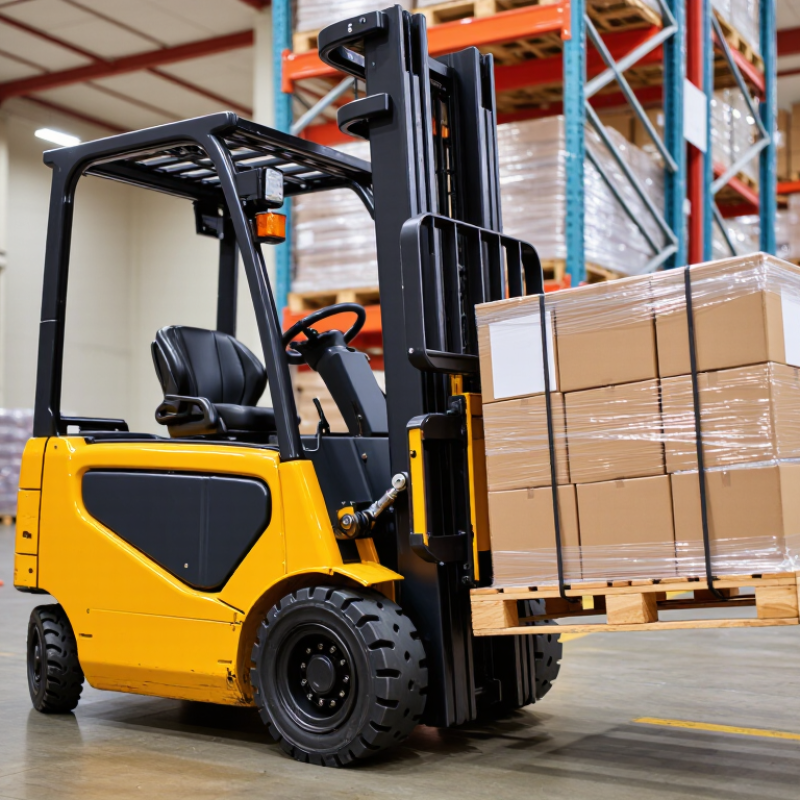
What Is a 3.5t Forklift and How Much Can It Lift?

A 3.5t Forklift is designed to lift loads weighing up to 3,500 kilograms under specific conditions. That figure is not a universal promise. It depends on the load centre, mast height, attachment type, and machine configuration. A compact pallet at the rated distance may be manageable. The same weight on a long fork extension can become unsafe.

Forklift safety trainer Dave Hoover offers a practical reminder: “Capacity is not just the number on the data plate; it is the load, the height, and the distance working together.” This statement captures the central issue clearly. Operators should read the capacity plate before moving any load. They should also inspect tyres, forks, hydraulics, brakes, and overhead guards. Small defects matter.

This guide will explain what a 3.5t Forklift is, how its lifting capacity is calculated, and why real-world performance may differ. It will examine counterbalance design, rated load centres, mast stages, attachments, and operating surfaces. A level concrete floor is very different from a sloped yard. Wet ground changes the risk again.

There is one uncomfortable detail. Some buyers focus only on the “3.5t” label. That shortcut can create dangerous assumptions. The forklift may lift 3,500 kilograms near the ground, yet less at maximum height. Manufacturer data remains essential. Local training and workplace procedures matter too. Even experienced operators can misjudge a shifting load. This article keeps that limitation visible while building a practical understanding of safe lifting performance.

What Is a 3.5t Forklift and How Much Can It Lift?

Defining a 3.5-Tonne Forklift: Rated Capacity and ISO 5053-1 Classification

A 3.5t forklift is commonly understood as a forklift with a 3,500-kilogram rated capacity. However, that figure is not an unlimited lifting promise. Rated capacity applies only under stated conditions, including the load centre, lifting height, mast configuration, and approved attachment. A data plate may show 3,500 kg at a 500 mm load centre, but the permitted load can fall sharply when the centre moves forward.

The load centre is easy to picture. Imagine a dense crate extending beyond the forks. Its weight creates more leverage against the forklift’s stability. Even a level pallet can exceed the safe rating if its heaviest section sits too far forward. I have seen capacity questions become confusing when users quote the machine’s name instead of reading the plate. The plate is more reliable.

ISO 5053-1 classifies industrial trucks by their type, design, and operating function. It helps distinguish a powered counterbalanced truck from other industrial truck categories. It does not mean every truck in that category lifts 3.5 tonnes. The “3.5t” description refers to rated capacity, while the ISO classification describes what kind of truck it is. Check both details. Also verify the attachment rating, floor condition, and load shape before lifting. These practical factors are sometimes overlooked, even by experienced teams. A small error matters.

How the 3,500 kg Rating Is Tested at a Standard 500 mm Load Centre

What Is a 3.5t Forklift and How Much Can It Lift?

A 3.5t forklift has a rated capacity of 3,500 kg under specified conditions. That number does not mean it can lift 3,500 kg at every height or distance. The key reference is the 500 mm load centre. This means the load’s centre of gravity sits 500 mm forward from the fork face. A typical 1,000 mm deep pallet creates this centre when evenly loaded.

Capacity testing examines stability, mast strength, hydraulic performance, and braking response. Test engineers place a controlled load on the forks, raise it to the stated height, and check whether the truck remains stable. The load must stay within the rated centre. If it moves forward, the forklift’s tipping forces increase sharply. Small details matter. Uneven pallets can change the real load centre.

The capacity plate records these limits, often showing different ratings for different lift heights or attachments. A sideshifter, clamp, or extended fork adds weight and moves the load forward. Both effects reduce available capacity. Operators should measure the load, inspect its condition, and confirm the plate before lifting. In field checks, people sometimes focus only on total weight. That is an understandable mistake, but it can produce an unsafe assumption. The 3,500 kg rating is a tested limit, not a daily target.

What Is a 3.5t Forklift and How Much Can It Lift?

A 3.5t forklift is rated to lift 3,500 kg at a standard 500 mm horizontal load centre, subject to the truck’s capacity plate, mast height, attachments, and operating conditions.

The chart shows the theoretical load capacity at different load centres if the 1,750 kg·m rated load moment remains constant: 3,500 kg × 0.5 m = 1,750 kg·m. Actual safe capacity may be lower and must always be taken from the forklift’s official capacity plate.

Why Mast Height, Load Centre, and Attachments Reduce Actual Capacity

What Is a 3.5t Forklift and How Much Can It Lift?

A 3.5t forklift is rated to lift 3,500 kilograms under specific test conditions. Those conditions usually include a defined load centre, mast height, and approved attachment. A common reference is a 500 mm load centre. The nominal load moment is therefore 1,750,000 kilogram-millimetres. At a 600 mm load centre, a simple calculation gives only about 2,917 kilograms. This is an estimate, not a safe working capacity. ISO 3691-1 and ANSI/ITSDF B56.1 require capacity information to reflect actual operating conditions.

Mast height can reduce residual capacity because the raised load moves the combined centre of gravity forward. Mast deflection and truck stability become more critical near maximum lift. Attachments create another reduction. A sideshifter, clamp, or fork extension adds weight and often pushes the load farther from the front axle. The capacity plate, not the “3.5t” label, controls the decision. HSE guidance HSG6 stresses checking the truck’s rated capacity before every lifting task. A practical check should record load weight, dimensions, height, attachment weight, and load centre. I have seen calculations fail when workers ignored packaging depth. Small errors matter. OSHA estimates that powered industrial trucks cause about 35,000 serious injuries annually in the United States. Never treat a theoretical figure as permission to lift.

What Is a 3.5t Forklift and How Much Can It Lift? - Why Mast Height, Load Centre, and Attachments Reduce Actual Capacity

Data dimension Typical or calculated value What it means in practice
Rated capacity 3,500 kg A 3.5t forklift is designed to lift up to 3,500 kg only under the exact conditions stated on its capacity plate.
Common rated load centre 500 mm The load centre is the horizontal distance from the fork face to the load’s centre of gravity. The rating is not a universal value for every load shape.
Rated load moment at 500 mm 1,750 kg·m Calculated as 3,500 kg × 0.5 m. This is a simplified reference moment, not a substitute for the manufacturer’s capacity chart.
Equivalent load at a 600 mm centre Approximately 2,917 kg* Using the simplified moment calculation: 1,750 ÷ 0.6 = 2,917 kg. Actual permitted capacity may be lower because of stability, mast strength, tyre loading, and hydraulic limits.
Equivalent load at a 1,000 mm centre Approximately 1,750 kg* Long or irregular loads create a greater overturning moment and can reduce the allowable load to about half of the nominal rating in this simplified example.
Typical mast lift-height range Approximately 3–6 m Mast options vary by configuration. A higher lift height usually requires a lower residual capacity because the raised load increases forward leverage and mast deflection.
Low-lift operating condition Usually the most favourable condition Loads carried close to the ground generally provide better stability than the same loads raised to stacking height.
High-lift operation Residual capacity must be checked The capacity plate may list different limits for free lift, maximum lift height, mast type, and back-tilt angle.
Attachment weight Must be included in the capacity calculation A fork positioner, clamp, rotator, jib, or other attachment consumes part of the truck’s lifting capacity and may move the combined centre of gravity forward.
Attachment effect Often a significant reduction The reduction depends on attachment mass, lost fork reach, attachment thickness, and the combined load centre. It cannot be determined from attachment weight alone.
Load distribution Centre of gravity should remain within the supported fork area A concentrated, uneven, liquid, flexible, or off-centre load can be less stable than a uniformly distributed load of the same total mass.
Ground and travelling conditions Flat, firm, level ground is preferred Slopes, potholes, uneven surfaces, turning, braking, and travelling with a raised load can reduce practical stability even when the static load is within the rated value.
Correct capacity reference The truck’s current capacity plate and attachment-specific chart The data plate takes priority over a nominal “3.5t” description. Confirm mast height, load centre, attachment, tyre type, and operating condition before lifting.
*Planning note: The equivalent-capacity figures are simplified load-moment calculations based on 3,500 kg at a 500 mm load centre. They are not certified residual capacities. Always use the forklift’s capacity plate and the approved rating for the actual mast, lift height, load centre, tyres, and attachment.

Reading the Capacity Plate: Residual Loads at Different Lift Heights

What Is a 3.5t Forklift and How Much Can It Lift?

A 3.5t forklift can lift up to 3,500 kilograms under specific rated conditions. That figure is not a universal promise. It usually applies to a standard load center, mast position, and approved attachment. The capacity plate shows the safer answer. It lists residual loads at different lift heights, often in kilograms. As the forks rise, the rated capacity commonly falls. A load lifted to five meters may be much lighter than one handled near the floor. Load shape matters too. A long crate moves the center of gravity forward. That can reduce capacity sharply.

Read every line on the plate before moving a load. Check lift height, load center distance, mast configuration, and attachment information. For example, a plate might allow 3,500 kg at 500 mm, but only 2,400 kg at a higher lift height. These numbers differ between machines. Never copy values from another forklift. A useful lesson from site checks is simple: operators often remember the headline capacity and overlook the small table. That mistake can happen quickly.

Tips: Measure the load when possible. Keep heavy items low during travel. Center the load fully on both forks. If the plate is damaged or unclear, stop and ask a qualified supervisor. Do not guess. Even a small forward shift can affect stability, and real loads are rarely as neat as training examples.

Applying ISO 22915 Stability Principles Before Lifting a Full Load

What Is a 3.5t Forklift and How Much Can It Lift?

Applying ISO 22915 Stability Principles Before Lifting a Full Load

A 3.5t forklift does not always lift 3.5 tonnes. Its rated capacity applies only under specified conditions, including load center, lift height, mast position, and attachment type. The capacity plate provides these limits. Read it before moving the forks.

ISO 22915 stability principles focus on the forklift’s balance during operation. A heavy crate positioned too far forward increases the overturning moment. Raising the mast also shifts the combined center of gravity upward. Uneven flooring, sharp turns, sudden braking, and a tilted load can reduce stability further. Keep the load low and slightly tilted back while traveling. Slow down before turning.

Check the load’s weight and dimensions first. Measure the load center from the fork face, not from the pallet edge. Inspect the forks, tires, mast chains, hydraulic lines, and overhead clearance.

The ground should be firm, level, and free from loose debris. A 3.5t rating may change when using a clamp, extension, or other attachment. That detail is often missed.

Do not guess.

Operators should compare the actual load with the capacity chart at the planned height and load center. If the figures are unclear, stop and ask a qualified supervisor or engineer. Even experienced teams can rush this check. That is where confidence becomes a hazard. A full load is acceptable only when the forklift, surface, attachment, and operating conditions remain within the stated limits.

Article Source:

Contact Us Today for a Free Quote

(800) 708-6036