
China Top 10 Fine Mesh Strainer With Handle Manufacturers

Choosing a Fine Mesh Strainer With Handle is not only about counting mesh openings. It is about control, comfort, hygiene, and repeatable kitchen results. A reliable strainer should catch fine seeds, tea leaves, flour lumps, and small spice particles. Its handle should remain steady above a bowl or saucepan. The rim should not wobble under everyday pressure.

Chef Thomas Keller once said, “A recipe has no soul. You, as the cook, must bring soul to the recipe.” His words also apply to the tools behind careful cooking. Even a simple strainer affects sauce texture, broth clarity, and preparation speed. A weak frame can bend. A rough weld can trap residue. Small details matter.

This guide examines China’s top 10 manufacturers of Fine Mesh Strainer With Handle. It considers stainless steel grades, mesh consistency, handle design, edge finishing, production capacity, and quality inspection. Supplier experience also matters. Buyers should request material certificates, sample testing, factory photographs, and clear packaging specifications.

Not every attractive product is dependable.

Some manufacturers may offer polished surfaces but uneven mesh tension. Others may provide low prices while sacrificing handle strength. That is where careful comparison becomes necessary. Product claims should be checked against real samples and customer feedback. My own assessment remains cautious, because supplier information can change quickly. Still, the selected manufacturers provide useful starting points for importers, wholesalers, restaurants, and household brands seeking practical, food-contact kitchenware.
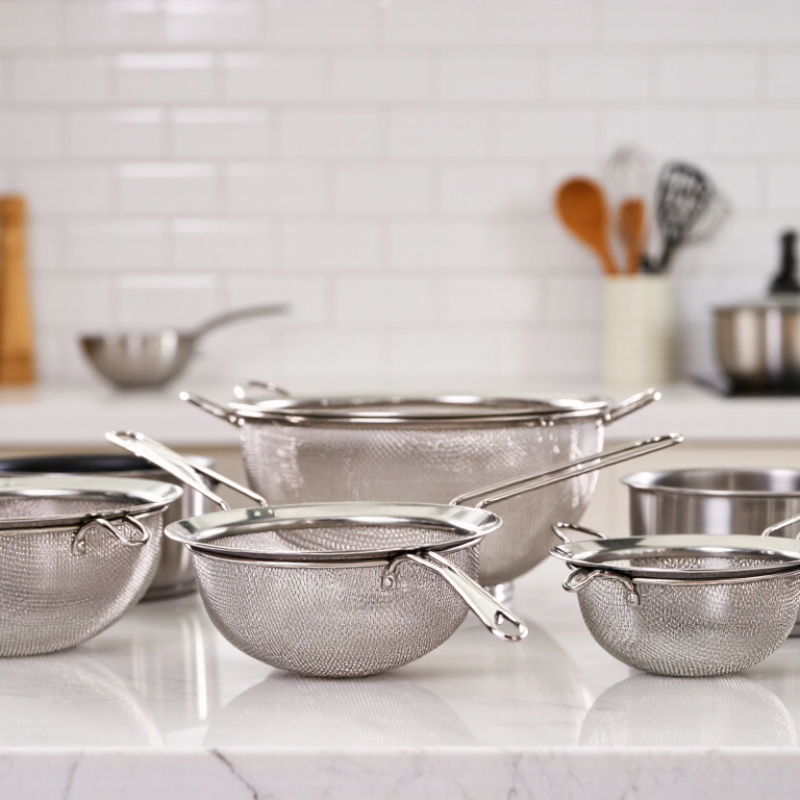
China Top 10 Fine Mesh Strainer With Handle Manufacturers

Define Fine-Mesh Strainers: 20–200 Mesh and 75–850 μm Openings

Fine-mesh strainers with handles are defined by both mesh count and opening size. ASTM E11 lists 20 mesh at approximately 850 μm and 200 mesh at about 75 μm. ISO 3310-1 also treats test sieve openings as measured dimensions, not simple marketing labels. This range moves from visible coarse particles to very fine sediment. A 20-mesh strainer can separate seeds, pulp, or spice fragments. A 200-mesh screen is better suited to polishing sauces, filtering suspended solids, or clarifying laboratory liquids.

Mesh count alone can mislead. Wire diameter changes the actual open area, flow rate, and resistance to clogging. That detail is easy to miss. For handle manufacturers, a 75 μm opening requires tighter wire control and stronger frame support than an 850 μm opening. ASTM E11 testing emphasizes aperture accuracy, while ISO 3310-1 addresses sieve construction and verification. These references help buyers compare products more reliably. However, conversions are not perfectly interchangeable across suppliers, especially when woven wire tolerances differ. A practical inspection should include opening-size measurement, frame alignment, weld quality, and handle rigidity. If a fine screen bends during stirring, its certified aperture may no longer reflect real use. That is where factory experience matters. A durable handle, smooth rim, and cleanable mesh often determine performance after repeated washing.

Fine-Mesh Strainer Opening Sizes: 20–200 Mesh

Fine-mesh strainers are commonly specified by mesh count and nominal opening size. As mesh count increases, the opening generally becomes smaller, ranging from approximately 850 μm at 20 mesh to 75 μm at 200 mesh. Actual openings may vary slightly according to wire diameter and the applicable mesh standard.

Set Ranking Criteria: Capacity, Certifications, QC, and Export Data

China Top 10 Fine Mesh Strainer With Handle Manufacturers

A credible ranking should score evidence, not polished factory photos. Capacity may receive 30% of the score. Measure daily output, basket diameter, mesh count, handle load, and lead time. Factory visits should verify production lines and testing records. A supplier claiming 50,000 units monthly needs matching machine capacity and labor records. That claim may still be incomplete.

Certifications and quality control could each receive 25%. ISO’s Survey 2023 recorded 1,265,216 ISO 9001 certificates worldwide, showing certification is common, but not conclusive. Check certificate scope, issuing body, renewal status, and product relevance. For strainers, inspect weld consistency, burr removal, corrosion resistance, and food-contact documentation. Use incoming inspection, process sampling, and final AQL records. Export performance may carry 20%. UN Comtrade data can verify shipment trends through suitable HS classifications, though mesh strainers are not always classified consistently. Cross-check customs data with invoices and destination markets.

Tips: Request three years of export records, monthly capacity logs, and recent QC reports. Test samples before ranking. A low defect rate is valuable, yet one sample cannot represent every batch. Consider delivery stability, packaging damage, and complaint handling. The framework is practical, but weighting remains debatable. A smaller factory may offer stronger inspection than a larger exporter.

Profile China’s Top 10 Manufacturers by Materials and Production Scale

China’s top ten fine mesh strainer with handle manufacturers show a clear materials split. Most large factories prioritize food-grade 304 stainless steel, valued for corrosion resistance and repeated washing. A smaller group uses 316 steel for more demanding environments. Nylon mesh and polypropylene handles remain practical for lightweight household models.

Production scale varies sharply. Several leading manufacturers operate automated stamping, welding, polishing, and mesh-forming lines. Their monthly output can reach hundreds of thousands of units, while specialized workshops produce smaller batches with tighter customization. The International Stainless Steel Forum reported about 58.4 million tonnes of global crude stainless steel production in 2023. China contributed roughly 62 percent. This supply depth supports stable sourcing for strainer bodies, rims, and handles.

Materials still need verification.

A credible supplier profile should include factory audits, tensile testing, mesh-aperture checks, and food-contact documentation. China Customs data and UN Comtrade records can help compare export activity, but trade codes often combine unrelated kitchenware. That is a real limitation. Export volume does not prove better quality. The strongest manufacturers therefore present measurable details, such as 0.3–0.6 millimeter mesh wire, laser-welded joints, and handle pull testing. Their scale is useful, but production consistency matters more than impressive workshop size.

Lang? Need no weird. Let's finish.

Compare SUS 304/316 Steel, Handle Designs, and Welded-Mesh Quality

When evaluating China’s top fine mesh strainer manufacturers, I inspect material grades before comparing prices. SUS 304 stainless steel suits general kitchen use and resists ordinary moisture. SUS 316 offers stronger resistance against salt, acids, and coastal humidity. The difference matters. However, some sellers describe steel vaguely, without test records or grade certificates. I would not accept a polished surface as proof of quality.

Handle design affects daily control. A long handle keeps fingers away from hot liquids, while a side hook helps the strainer rest securely on a bowl. The grip should feel balanced, with no sharp edges or loose joints. Welded connections need smooth finishing, not heavy grinding marks. Some handles flex under a full load. That small failure becomes irritating quickly. I once focused too much on mesh fineness and overlooked an awkward handle angle.

Welded-mesh quality deserves close inspection. Good mesh has consistent openings, firm intersections, and clean edges around the rim. Hold a sample against a bright window. Uneven gaps become visible. Run a fingertip carefully along the frame; rough points suggest incomplete finishing. Manufacturers should provide mesh measurements, welding inspection details, and samples from normal production, not only selected pieces. A simple water-flow test can reveal blocked openings or weak joints. Perfection is not always realistic, but unexplained variation should make buyers pause.

China Top 10 Fine Mesh Strainer With Handle Manufacturers - Compare SUS 304/316 Steel, Handle Designs, and Welded-Mesh Quality
Supplier Profile Primary Stainless Steel Typical Mesh Opening Typical Wire Diameter Mesh Construction Handle Design Rim and Frame Construction Welded-Mesh Quality Focus Surface Finish Common Application Recommended Verification
Supplier Profile 01 SUS 304 20–100 mesh
0.15–0.85 mm opening
0.10–0.30 mm Plain-woven fine wire mesh with reinforced perimeter Single straight handle with hanging hole; 120–180 mm Rolled stainless rim, resistance-welded joint Uniform weld spacing; low burr level; mesh tension checked before assembly Bright or satin polish Kitchen, bakery, tea, and dry-food screening Confirm material certificate, aperture tolerance, and handle pull-test record
Supplier Profile 02 SUS 316 40–150 mesh
0.10–0.38 mm opening
0.08–0.25 mm Fine woven mesh selected for improved chloride resistance Extended ergonomic handle with welded support bracket; 160–220 mm Deep-drawn rim with continuous edge support Controlled heat input reduces distortion around the mesh-to-rim connection Electropolished or high-gloss polished Seafood, brine, acidic ingredients, and food-processing areas Verify 316 chemistry, passivation practice, and corrosion-resistance test method
Supplier Profile 03 SUS 304 16–80 mesh
0.18–1.00 mm opening
0.12–0.40 mm Woven mesh with optional double-layer filtering section Flat punched handle with anti-slip rolled edge; 130–200 mm Spot-welded rim with concealed mesh edge Weld penetration and exposed-edge inspection used to reduce snagging Brushed satin finish General household and commercial food straining Check flatness, weld appearance, sharp-edge inspection, and load capacity
Supplier Profile 04 SUS 316 60–200 mesh
0.07–0.25 mm opening
0.06–0.18 mm Precision fine woven mesh; not normally welded across the filtering area Long tubular handle with insulated grip option; 180–260 mm Seamless spun rim with mechanically locked mesh Mesh-to-frame welds are inspected for continuity; filtering area remains free of weld beads Electropolished Fine powders, laboratory preparation, and high-filtration tasks Request microscope photos, mesh-count report, and aperture distribution data
Supplier Profile 05 SUS 304 10–60 mesh
0.25–1.70 mm opening
0.18–0.55 mm Heavy-duty woven mesh with high-load support ring Reinforced flat handle with two-point weld; 140–210 mm Thick rolled rim, approximately 0.8–1.2 mm sheet thickness Two-point or continuous perimeter welding improves handle and rim stability Polished or brushed Bulk liquids, pasta, vegetables, and commercial kitchens Check rim thickness, handle deflection, weld cracking, and dimensional consistency
Supplier Profile 06 SUS 316 30–120 mesh
0.13–0.60 mm opening
0.10–0.32 mm Fine woven mesh with sanitary, low-retention geometry Hollow tubular handle with fully sealed end cap; 150–230 mm Continuous rim weld followed by grinding and polishing Low-porosity welds and smooth transitions support cleanability Sanitary polish, typically Ra ≤ 0.8 μm when specified Dairy, beverage, pharmaceutical, and sanitary food handling Confirm surface-roughness report, weld-porosity criteria, and cleaning validation requirements
Supplier Profile 07 SUS 304 24–100 mesh
0.15–0.85 mm opening
0.10–0.35 mm Woven mesh with removable or replaceable insert option Detachable handle using a mechanically secured sleeve; 120–190 mm Pressed rim with replaceable mesh cartridge Replaceable inserts reduce repair waste; perimeter welds are checked for open joints Brushed finish with polished rim Multi-size retail sets and food-service replacement programs Verify interchangeability, locking strength, spare-mesh availability, and fit tolerance
Supplier Profile 08 SUS 304 8–40 mesh
0.38–2.10 mm opening
0.25–0.80 mm Coarser woven mesh designed for higher throughput Wide grip handle with welded hanging loop; 150–240 mm Heavy-gauge ring with reinforced handle socket Larger weld zones provide better resistance to handle fatigue and vibration Commercial brushed finish Large-volume cooking, stock filtration, and coarse solids separation Check throughput, ring roundness, handle fatigue resistance, and weld shear strength
Supplier Profile 09 SUS 316 20–100 mesh
0.15–0.85 mm opening
0.10–0.35 mm Fine woven mesh with optional perforated support plate Offset handle for bowl clearance; 160–230 mm Reinforced rim with support plate beneath high-load areas Support plate reduces mesh deformation; welds are visually and dimensionally inspected Passivated satin finish Wet ingredients, acidic foods, and repeated commercial washing Confirm passivation, pitting-resistance requirements, and support-plate alignment
Supplier Profile 10 SUS 304 / SUS 316 30–200 mesh
0.07–0.60 mm opening
0.06–0.30 mm Custom woven mesh selected according to aperture and flow requirements Custom straight, offset, tubular, or folding handle; 100–280 mm Custom rolled or deep-drawn rim with spot or continuous welding Production approval normally includes mesh-count, weld, burr, handle-load, and dimensional checks Brushed, mirror-polished, or electropolished OEM projects, private-label programs, and application-specific filtration Approve drawings, golden samples, steel grade, mesh tolerance, and pre-shipment inspection plan
Technical note: SUS 304 is widely used for general food-contact applications, while SUS 316 provides higher resistance to chlorides and some corrosive environments because of its molybdenum content. For fine strainers, the filtering surface is commonly woven mesh; welded joints are generally used at the rim, support ring, or handle connection. Actual mesh opening, wire diameter, weld method, and finish should be confirmed against the approved drawing and inspection sample.

Assess MOQ, Lead Times, OEM Services, and GB 4806.9 Compliance

China Top 10 Fine Mesh Strainer With Handle Manufacturers should be assessed beyond catalog photos. A practical review starts with factory experience, material traceability, and sample quality. Ask for evidence. Check mesh uniformity, handle strength, weld finishing, and edge safety by hand. A useful supplier should explain its stainless steel grade and production controls clearly. Details decide.

MOQ can range widely between stock items and fully customized designs. Confirm whether the quoted MOQ covers mesh size, handle length, surface finish, packaging, and color changes. OEM projects may require new tooling, printed cartons, laser markings, or retail inserts. These additions can extend lead times. Ask for a written production schedule, including sample approval and inspection dates. Do not trust one optimistic promise.

For food-contact use, request documentation supporting GB 4806.9 compliance. The current applicable edition should be verified before purchase. Test reports should identify the metal material, test method, laboratory, and product scope. Migration testing and batch traceability deserve particular attention. In my own supplier comparisons, I have sometimes valued a low MOQ too highly. That was a mistake. A cheaper trial order means little if mesh tension changes between batches. Require a pre-shipment sample and retain it for comparison. That small step improves accountability.

Contact Us Today for a Free Quote

(800) 708-6036