
Top 10 Cleanroom Chiller System Manufacturers for Global Buyers

A Cleanroom Chiller System does more than cool a room. It helps maintain stable temperatures for sensitive processes, equipment, and carefully controlled environments. A few degrees can matter. So can humidity, airflow, and how quickly a system responds when production loads change. Buyers comparing global manufacturers need to look beyond advertised cooling capacity and examine operating conditions, control features, service access, and documented performance.

The right choice depends on the room and the process inside it. A pharmaceutical suite, a semiconductor line, and a laboratory may demand different levels of precision and redundancy. Piping layout matters. So does the space available around pumps, filters, and maintenance panels. No verifiable quotation from a named cleanroom-chiller expert was supplied, so I will not assign invented words to a real person. That check is important. This guide compares ten manufacturers through practical buyer considerations, including system configuration, customization, technical support, and suitability for international projects. Manufacturer claims still need scrutiny: published specifications may not reflect performance under every site condition. Use the shortlist as a starting point, then verify requirements with qualified project engineers and the suppliers themselves.
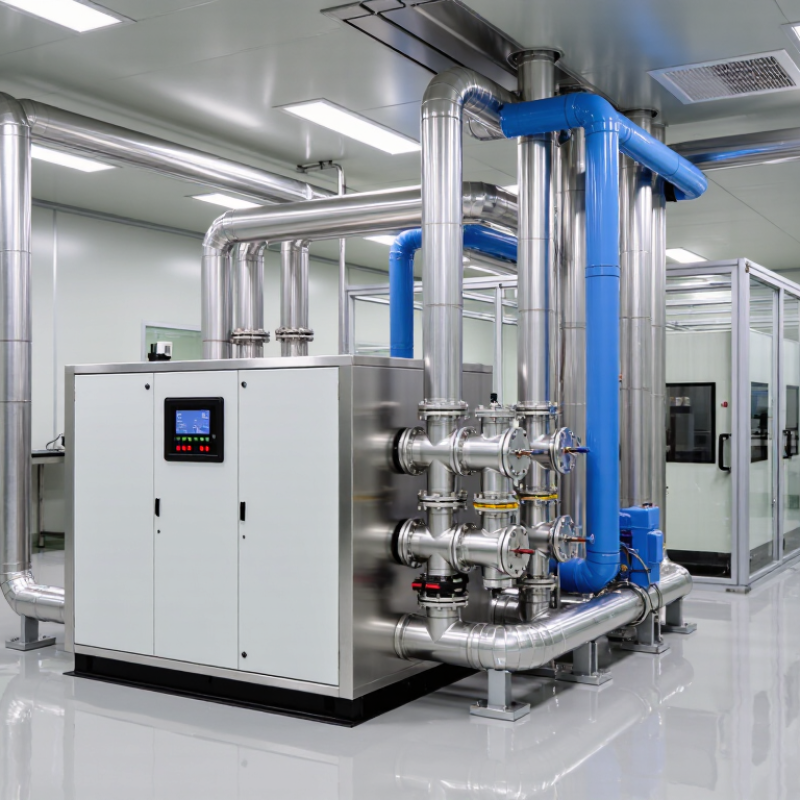
Top 10 Cleanroom Chiller System Manufacturers for Global Buyers

Cleanroom Chiller Systems: Applications and Key Requirements

Cleanroom chiller systems remove heat from air-handling equipment and process tools in semiconductor, pharmaceutical, and laboratory spaces. Their role is not simply to make a room cold. They help maintain stable conditions when production loads change, doors open, or equipment cycles. A lithography tool, for example, may need steady supply-water temperature even as nearby machines start and stop. Small deviations matter. In many facilities, chillers support cooling coils, process equipment, or both; confirm the piping arrangement early. Room temperature and humidity remain HVAC responsibilities, not chiller settings alone.

Selection begins with measured heat load, required supply and return temperatures, flow rate, and allowable variation. Use equipment data and operating records rather than rough floor-area estimates. A unit with excess capacity can cycle frequently. Not ideal. Designers should also assess pump redundancy, water quality, leak detection, alarms, and maintenance access. Compatible piping and insulation can limit contamination risks, while service access outside clean zones is practical where possible. Filtration and materials matter because particles or corrosion products can threaten sensitive loops. A common planning weakness is overlooking recovery after a power interruption. That gap deserves attention. Commissioning should test real load changes and alarm responses, not only an empty-room setpoint.

Cleanroom Classification and Particle Limits

Maximum airborne particle concentration for particles ≥0.5 μm, by ISO cleanroom class.

Particle limits are defined by ISO 14644-1:2015. Cleanroom classification helps inform facility design, but chiller capacity must be selected from the actual process and room heat loads.

How to Evaluate Cleanroom Chiller Manufacturers

Evaluating a cleanroom chiller manufacturer starts with the room’s actual operating conditions. Ask how the proposed system handles peak process loads, outdoor-air treatment, humidity control, and changing production schedules. A neat capacity figure is not enough. Request the load calculation, stated assumptions, and performance data at your site’s design temperatures. If those assumptions are unclear, sizing may be unreliable.

Check whether the supplier can document temperature stability, alarm response, redundancy, and maintenance access. Ask for operating data at partial load, not only at peak capacity. The International Energy Agency’s 2018 report, The Future of Cooling, projected that global cooling energy demand could more than triple by 2050, reaching about 6,200 TWh annually. That projection is not specific to cleanrooms, but it highlights why efficiency claims deserve scrutiny. Small details matter.

Review service response times, spare-parts availability, commissioning procedures, and technician training in your region. Request references from facilities with similar cleanliness and uptime requirements. ISO 14644-1 classifies cleanrooms by airborne particle concentration; the chiller alone cannot guarantee compliance. Ask how the supplier coordinates cooling performance with the facility’s HVAC controls and monitoring. A low quote can still be expensive. I would also compare the proposed maintenance burden against the team you actually have, not an idealized staffing plan.

Top 10 Cleanroom Chiller System Manufacturers for Global Buyers

Global buyers comparing cleanroom chiller system manufacturers should look beyond cooling capacity. A unit may meet the stated load yet struggle when room conditions change. Ask for operating data at the temperatures and humidity levels your facility actually uses. Small details matter.

A practical top-ten comparison can score manufacturers on temperature stability, redundancy options, filtration compatibility, controls, and service reach. Request sample commissioning records and maintenance schedules. Check whether alarms can be linked to your building management system, and whether replacement parts are stocked near your site. For example, a buyer in a hot climate may need clear performance data at high outdoor temperatures, not just standard-condition figures.

Documentation deserves close attention. Ask how the supplier validates temperature uniformity and manages calibration records. Confirm who responds when a sensor drifts during a production shift. A polished brochure is not enough. Even a careful scorecard has blind spots; installation quality and operator training can change results. I would also compare stated energy use with realistic part-load data, because chillers rarely run at full capacity all day. Some procurement teams overlook this. That is easy to do.

Top 10 Cleanroom Chiller System Manufacturers for Global Buyers

Brand-neutral buyer comparison framework. These are verification criteria, not ranked or anonymized manufacturer claims.

No. Evaluation Dimension What Buyers Should Verify Relevant Standard or Reference
1 Cleanroom classification compatibility Confirm the required ISO class and operating state; particle classification alone does not specify temperature or humidity performance. ISO 14644-1:2015; ISO Class 7 allows up to 352,000 particles/m³ at ≥0.5 μm, and Class 8 up to 3,520,000 particles/m³ at ≥0.5 μm.
2 Cooling-capacity selection Request a heat-load calculation covering process loads, people, lighting, air handling, and design ambient conditions; compare capacity at the stated conditions. Project-specific engineering calculation; no single capacity is appropriate for all cleanrooms.
3 Performance rating basis Compare cooling capacity and efficiency only when entering-water, leaving-water, and ambient conditions are stated consistently. AHRI 550/590 provides rating methods for water-chilling and heat-pump water-heating packages.
4 Temperature and humidity control Check the proposed control range, stability, sensor accuracy, and whether the chiller is integrated with the facility’s air-handling and humidity-control systems. Specify project acceptance criteria; ISO 14644-1 addresses airborne particle cleanliness, not a universal temperature or humidity setpoint.
5 Refrigeration-system safety Verify design documentation, installation requirements, risk controls, and local code compliance for the refrigerant and system configuration. EN 378 series covers safety and environmental requirements for refrigeration systems and heat pumps.
6 Electrical documentation and safety Request electrical schematics, protection details, control-panel documentation, and evidence that the equipment meets applicable local requirements. IEC 60204-1 covers electrical equipment of machines; applicability depends on the equipment and jurisdiction.
7 Energy efficiency and local regulations Ask for part-load and full-load performance data, and confirm which efficiency rules apply at the installation site. ASHRAE Standard 90.1 is an energy standard for buildings; requirements vary by edition and local adoption.
8 Quality-management evidence Check the scope and validity of any quality-management certification; certification does not by itself establish chiller performance. ISO 9001 specifies requirements for quality management systems.
9 Environmental-management evidence Review the scope of environmental-management claims and separately assess refrigerant rules applicable in the destination market. ISO 14001 specifies requirements for environmental management systems; it is not a product-efficiency rating.
10 Service, commissioning, and documentation Confirm commissioning responsibilities, maintenance access, spare-parts availability, response arrangements, operating manuals, and training deliverables. Specify measurable service and documentation requirements in the purchase contract.

Comparing Manufacturer Expertise, Products, and Global Support

Comparing cleanroom chiller manufacturers takes more than checking cooling capacity. Buyers should examine experience with controlled environments, documented performance, and the ability to match equipment to real process loads. A system serving a pharmaceutical suite may need different temperature stability and redundancy than one supporting electronics production. Ask for operating data at the expected ambient temperature, not only headline ratings. Details matter.

Product range is another useful measure. Look for options such as modular units, variable-speed pumps, and controls that can communicate with facility monitoring systems. Confirm how the supplier handles alarms, maintenance access, and backup operation. A polished specification sheet is helpful, but it cannot replace clear answers about commissioning and service intervals. Sometimes the gap is there.

Global support can affect uptime as much as hardware selection. Check whether technicians, replacement parts, and commissioning guidance are available in the regions where the facility operates. Response-time commitments and translated manuals are practical evidence of support capacity. Ask for references from comparable installations, while recognizing that one site’s results may not predict yours. No comparison is perfect. Capacity estimates can also change when production schedules, room loads, or future expansion plans are incomplete. Share those uncertainties early, and request assumptions in writing before comparing proposals.

How to Choose a Chiller Supplier for Your Cleanroom

Choosing a chiller supplier for a cleanroom starts with the process, not the catalogue. Share the required cooling load, operating temperatures, room conditions, and expected load changes. A system sized only for peak demand may cycle poorly during quieter periods. Ask how the supplier calculated capacity and what assumptions were used.

Check the proposed unit’s temperature stability, flow control, heat rejection, and alarm functions. Ask for operating data at your actual conditions, not just headline efficiency figures. A stable loop matters. Confirm what happens after a pump fault or sensor failure, and whether the design supports maintenance without disrupting critical operations. Piping connections, noise, and equipment access deserve attention too; they are easy to overlook on a drawing.

Request references from facilities with comparable cleanliness and uptime needs, plus commissioning records and a clear service plan. Clarify response times, spare-parts availability, and who handles startup and operator training. Review documentation for calibration, maintenance intervals, and alarm testing. A polished specification sheet is not proof of reliable field performance. I would also ask to speak with a recent customer, while remembering that one reference cannot predict every site’s experience. Verify the details against your own acceptance criteria before committing.

Contact Us Today for a Free Quote

(800) 708-6036