Choosing a reliable fiber laser cutter is not simply a matter of comparing prices. Global buyers must examine cutting speed, laser power, material thickness, automation, software, and after-sales support. A machine that performs beautifully on stainless steel may struggle with reflective brass or thick aluminum. Real production trials matter.
Valentin Gapontsev, founder of IPG Photonics, once said, “Fiber lasers are the future of industrial lasers.” His statement reflects the technology’s influence on modern metal fabrication. Today, a fiber laser cutter can deliver narrow kerfs, clean edges, lower maintenance needs, and strong energy efficiency. However, these advantages depend on correct configuration and disciplined operation.
This guide reviews leading fiber laser cutter manufacturers for international buyers. It considers engineering experience, product reliability, global service networks, warranty terms, user feedback, and long-term operating costs. Brand reputation helps, but it is not enough. Some smaller manufacturers offer excellent value, while some famous names may not suit every factory.
Details matter.
Buyers should verify the power source, cutting head, motion system, control software, and replacement-part availability. They should also request sample cuts using their own materials. That step is often skipped, and the decision becomes less reliable. Certification, operator training, installation support, and local technical assistance deserve equal attention.
No ranking is perfect. Manufacturing needs differ across regions and industries. This overview therefore aims to support careful comparison, not replace technical evaluation. A trustworthy purchase begins with evidence, realistic expectations, and a clear understanding of production goals.
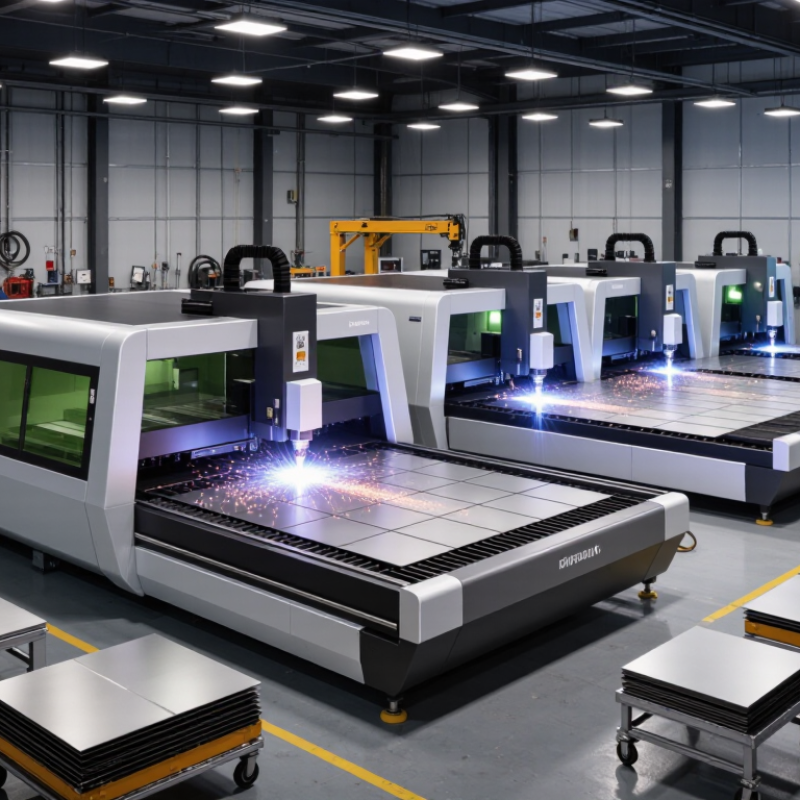
Fiber laser cutters commonly operate near 1.03–1.08 μm, a wavelength range well suited to industrial metals. This band supports efficient beam delivery through optical fiber and strong absorption in steel, stainless steel, and aluminum. Technical reviews from the Fraunhofer Institute for Laser Technology report electrical-to-optical efficiencies commonly around 25–35% for high-power fiber sources. That figure describes wall-plug efficiency, not the percentage of material removed.
The practical advantage appears at the cutting head. A focused beam can create a narrow kerf, while assist gas ejects molten metal from the cut zone. U.S. Department of Energy industrial efficiency guidance identifies process control, standby power, and compressed-air demand as major energy variables. Therefore, a 30% source efficiency does not guarantee a 30% lower cutting cost. No machine behaves perfectly.
Thickness, alloy, nozzle condition, and focus position change results. Aluminum can reflect more incident energy than mild steel, especially during piercing. Poor lens cleanliness can enlarge the spot and increase heat-affected edges. The International Organization for Standardization’s laser-processing standards also emphasize controlled measurement conditions, which many online comparisons omit. Buyers should request test data showing material grade, thickness, cutting speed, assist-gas pressure, and measured electrical input. A fair comparison needs all five. Even then, factory data may look better than production-floor results. That difference deserves attention.
Fiber laser cutting systems commonly operate around the 1.03–1.08 μm wavelength band, with typical electro-optical efficiency in the 25–35% range. The chart shows representative reference points within these commonly reported ranges; actual performance varies by system design, power level, and operating conditions.
Reliable manufacturers should provide measurable evidence, not only impressive brochures. Buyers should request sample cuts using their actual material, thickness, nozzle type, and assist gas. Examine edge roughness, dross, piercing time, and heat distortion. Ask for service response times, spare-part availability, operator training, and installation requirements. These details often matter more than a small difference in headline power.
A high-power quote can look attractive. It may still be inefficient for low-volume work. Electricity, compressed gas, consumables, and maintenance increase with machine size.
In practical evaluations, the best system matches daily plate thickness and production rhythm. Some suppliers offer broad power ranges, yet their automation or software may feel underdeveloped. That weakness deserves attention. A dependable manufacturer explains limitations clearly, supports acceptance testing, and publishes realistic tolerances. Buyers should also inspect the factory’s quality records, calibration process, and long-term service network before signing.
Global buyers often compare fiber laser cutter manufacturers by power, bed size, and automation. In machine evaluations, I examine cut samples, maintenance records, and operator feedback. A reliable manufacturer should explain limitations clearly, not only advertise speed. That honesty matters when production schedules are tight.
Laser power should match the material and thickness range. A 3 kW system suits many sheet-metal applications, while higher power supports thicker steel and faster production. More power is not always better. It can increase energy use and operating costs. Bed size also affects efficiency. A 1500 × 3000 mm table fits common sheets, while a 2000 × 4000 mm bed reduces repositioning for larger parts. Shop space must be measured carefully.
Automation becomes valuable when orders repeat daily. Automatic loading, unloading, nozzle changing, edge detection, and height sensing can reduce idle time. Software should support nesting, production tracking, and clear error messages. I have seen impressive demonstrations fail during long shifts. A perfect specification sheet can still hide weak service support. Ask manufacturers for test cuts, spare-parts availability, training details, and realistic delivery terms. Electrical certifications and local safety compliance should also be verified before purchase. A small error here can become expensive.
| Manufacturer Capability Profile | Typical Laser Power | Common Working Area | Typical Mild-Steel Cutting Range | Automation Level | Best-Fit Production Use | Typical Positioning Accuracy | Global Buyer Considerations | Overall Suitability |
|---|---|---|---|---|---|---|---|---|
| Compact Sheet-Metal Configuration | 1–3 kW | 1,500 × 3,000 mm | Thin to medium sheet, commonly up to approximately 12–20 mm | Manual loading with powered shuttle table optional | Job shops, signage, electrical cabinets, and general fabrication | Approximately ±0.03 mm under suitable operating conditions | Low installation footprint, moderate power demand, and comparatively simple operator training | ★★★★★ |
| Standard Industrial Sheet Cutter | 3–6 kW | 1,500 × 3,000 mm or 2,000 × 4,000 mm | Medium sheet, commonly up to approximately 20–30 mm | Automatic shuttle table with optional edge finding and nesting software | Contract manufacturing, machinery parts, appliances, and HVAC components | Approximately ±0.03 mm under suitable operating conditions | Balanced choice for throughput, operating cost, material flexibility, and maintenance access | ★★★★★ |
| High-Productivity Production System | 6–12 kW | 2,000 × 4,000 mm or 2,500 × 6,000 mm | Medium to thick plate, commonly up to approximately 30–40 mm | Automatic pallet changer with optional tower storage and loading system | Automotive suppliers, steel service centers, and high-volume fabrication | Approximately ±0.05 mm under suitable operating conditions | Requires stable power, efficient fume extraction, trained maintenance staff, and reliable consumable supply | ★★★★★ |
| Heavy-Plate Fiber Laser System | 12–20 kW | 2,500 × 6,000 mm or 3,000 × 6,000 mm | Thick plate applications, commonly up to approximately 40–60 mm depending on material and process settings | Automatic loading and unloading with pallet exchange and production monitoring | Heavy equipment, structural components, shipbuilding, and steel processing | Approximately ±0.05 mm under suitable operating conditions | Higher capital cost and utility requirements; verify assist-gas capacity and heat-management design | ★★★★☆ |
| Extra-Large Format Cutting System | 6–20 kW | 3,000 × 8,000 mm to 3,000 × 13,000 mm | Thin to heavy plate, depending on installed power, material grade, and cutting head configuration | Automated storage, conveyor loading, and unloading integration available | Long structural parts, rail components, agricultural equipment, and large frames | Approximately ±0.05–0.10 mm under suitable operating conditions | Requires substantial floor space, long-material handling, safety zoning, and customized logistics planning | ★★★★☆ |
| Tube and Sheet Combination System | 3–12 kW | Sheet bed of 1,500 × 3,000 mm to 2,000 × 6,000 mm | Sheet capacity commonly up to approximately 20–40 mm; tube capacity depends on chuck and tube length | Sheet cutting combined with rotary tube chuck and optional automatic tube loading | Furniture, fitness equipment, construction machinery, and tubular frames | Approximately ±0.05 mm under suitable operating conditions | Check maximum tube diameter, tube weight, residual-length handling, and software compatibility | ★★★★★ |
| High-Automation Factory Cell | 6–20 kW | Commonly 2,000 × 4,000 mm or 2,500 × 6,000 mm | Medium to heavy sheet and plate according to the selected laser source | Robotic loading, unloading, storage tower, barcode tracking, and production scheduling | 24-hour production, multi-shift factories, and standardized high-volume parts | Approximately ±0.05 mm under suitable operating conditions | Evaluate software integration, spare-parts response, remote diagnostics, safety certification, and operator training | ★★★★★ |
| Entry-Level Manual Production System | 1–2 kW | 1,500 × 3,000 mm | Thin sheet, commonly up to approximately 8–12 mm in mild steel | Manual loading and unloading with basic CNC nesting | Small workshops, prototyping, repair work, and low-volume custom fabrication | Approximately ±0.05 mm under suitable operating conditions | Suitable where purchase price and simplicity are more important than maximum throughput | ★★★★☆ |
Note: Cutting thickness, accuracy, cycle time, and automation performance vary with material type, grade, assist gas, nozzle selection, cutting head, machine configuration, and operating conditions. Buyers should request a sample-cut test and a complete technical specification before placing an order.
Global buyers should judge fiber laser cutters through measured results, not impressive showroom demonstrations. Accuracy begins with a repeatable test using the buyer’s actual metal thickness, sheet size, and cutting pattern. Ask for dimensional reports, edge photographs, and records from several production runs. Small holes, narrow corners, and long straight cuts reveal different weaknesses. A clean sample is not enough.
Speed must be evaluated with quality included. Faster movement can increase taper, dross, or heat distortion. Request cycle times for complete parts, including piercing and handling, rather than quoting travel speed alone. Check acceleration, nesting software, laser power stability, and downtime records. Factory experience matters here. A machine that cuts quickly but needs frequent adjustment may cost more during real production.
I once trusted a fast demonstration too quickly.
Safety documentation deserves equal attention. ISO 12100 supports a structured process for identifying hazards and reducing risks through design, guarding, controls, and instructions. Buyers should review the risk assessment, emergency-stop layout, interlock tests, and maintenance procedures. Ask whether the documentation matches the delivered configuration. Generic files are a warning sign.
CE compliance should also be verified carefully. CE marking indicates conformity with applicable European requirements; it is not an independent quality award. Request the EU Declaration of Conformity, technical documentation, and relevant test evidence. Confirm the machine’s electrical, mechanical, and software features match those documents. Details matter. A missing translation or unclear responsibility can delay installation. Independent inspection is sensible, although it cannot replace practical testing.
Purchase price rarely reveals a fiber laser cutter’s real financial burden. The U.S. Department of Energy’s Industrial Decarbonization Roadmap identifies energy intensity and equipment utilization as major industrial cost drivers. Measure actual machine demand, not brochure ratings. A 10 kW average load, running 4,000 hours yearly at $0.12 per kWh, costs about $4,800 in electricity. Regional tariffs can change this sharply. Eurostat reported average EU non-household electricity prices near €0.18 per kWh in early 2023.
Small parts matter. Nozzles, protective windows, lenses, filters, and assist gases create recurring expenses. A purchasing team should record consumption per cutting hour and per finished sheet. Gas usage often rises after poor parameter settings or damaged seals. That is expensive.
Maintenance records should show mean time between failures, service response time, and planned downtime. ISO 22400 provides a useful framework for production-performance indicators. Warranty terms need equal precision: coverage period, excluded wear parts, labor costs, travel charges, and guaranteed response windows.
A two-year warranty may protect little if critical optics are excluded. Read the conditions carefully.
I would not trust a total-cost model using perfect uptime. It is too optimistic. Include rejected parts, operator training, software updates, and emergency service. Request twelve months of measured energy and consumable data from comparable applications. Then test the assumptions with local electricity and gas prices.